

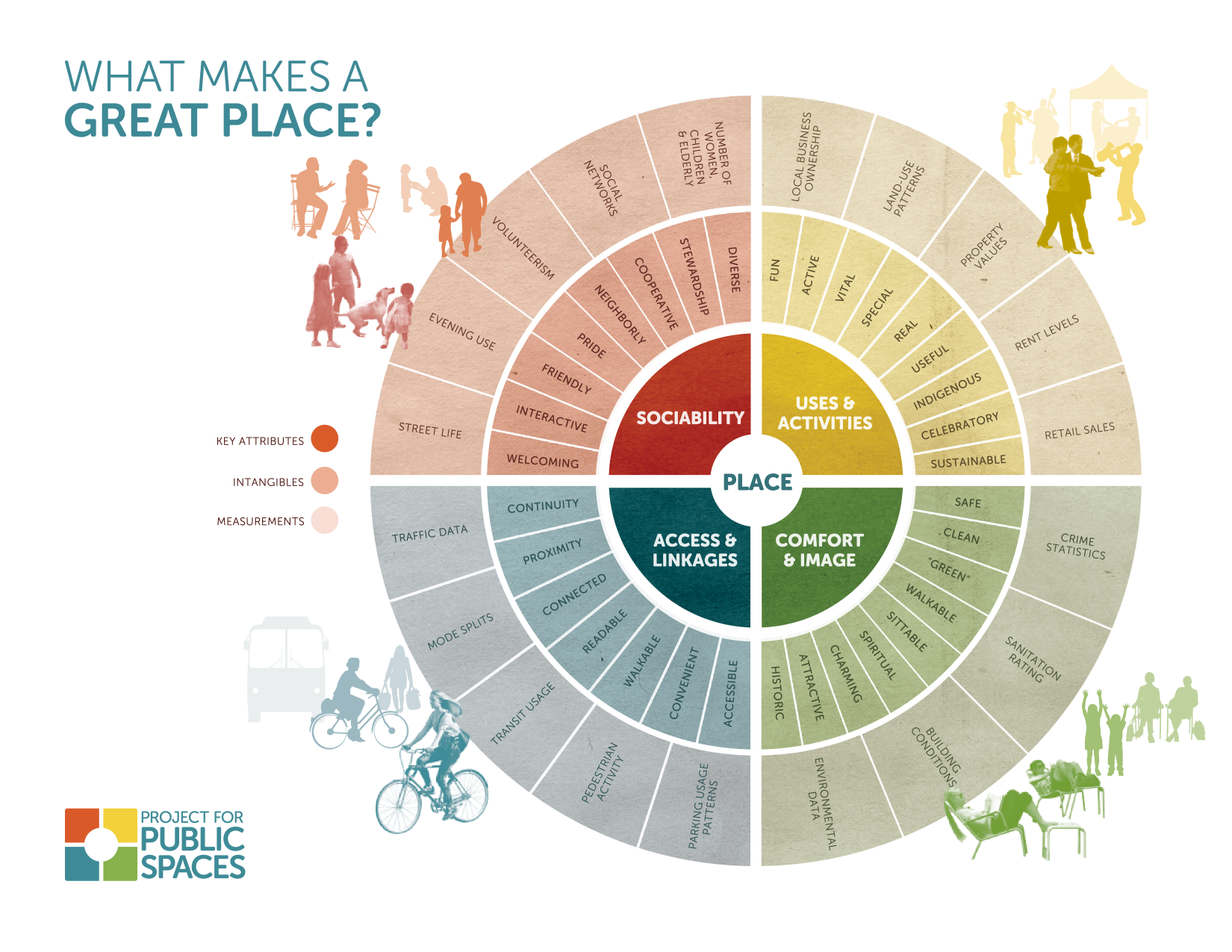
A successful public space generally needs to offer four qualities: it should be accessible, it should be comfortable and have a good image, people should be able to engage in an array of activities, and, it should be sociable. With these characteristics in mind, the possibilities are endless as to what type of public space can be successful, whether it’s a street, waterfront, playground, market, or park.
Looking even more closely at the qualities of the Place Diagram, we’ve identified a few other attributes that contribute to making a public space great. While being a place to meet, a place for exchange, or a place of local or national pride, great public spaces can also be characterized by the presence of people remaining when they have no pressing reason to stay. You might call this the “lingering factor.” Successful public spaces are also well-managed: this includes cleaning, offering food or services, or scheduling events, and such implementations can be managed the community, by individuals, by the city or district, or through local partnerships.
Great public spaces also serve as the heart of a community, often connecting two or more separate neighborhoods together, and encouraging a central point where people can interact and participate in the public realm. Another important but sometimes overlooked element of great public spaces is their ability to highlight an area’s cultural identity – whether through local practices, location, history, design, architecture, or art. This is crucial factor for creating a sense of place that can withstand the test of time. For more information go to https://www.pps.org/article/grplacefeat
 We Like Watertown